
USGBC released LEED v5 on 28 April 2025. It keeps the familiar shape (110 points, with Certified at 40, Silver at 50, Gold at 60 and Platinum at 80) and changes almost everything underneath. Roughly half the points now serve decarbonization, a quarter quality of life and a quarter ecological conservation and restoration. Several things that used to be optional credits are now prerequisites, and some of them have to be done while the design is still a massing model.
For a project in Saudi Arabia starting now, there is also a choice of version to make, and it is a real one.

The prerequisites that arrive at concept
Three assessments open the rating system, in the Integrative Process category, and each is a document the design team produces early, not a form filled at submission.
| Prerequisite | What it asks for | Why it matters in Saudi Arabia |
|---|---|---|
| IPp1 Climate Resilience Assessment | An assessment of observed, projected and future natural hazards that affect the site and the building's function. | Extreme heat is the hazard that shapes the envelope, the plant and the outdoor spaces. |
| IPp2 Human Impact Assessment | Demographics, local infrastructure and land use, human use and health impacts, and occupant experience. | Frames shading, walkability and access in a climate where the outdoors is hostile for months. |
| IPp3 Carbon Assessment | A 25-year projection of emissions from operations, refrigerants and embodied carbon, assembled from other prerequisites. | Cooling dominates operation, so the projection is only as good as the energy model. |
| EAp1 Operational Carbon Projection and Decarbonization Plan | Early analysis of efficiency, peak load reduction and decarbonization, an estimate of annual site energy use and a 25-year plan. Projects earning 4–5 points in Electrification are exempt. | Peak cooling load, not annual energy alone, sizes the plant and the grid connection. |
| MRp2 Quantify and Assess Embodied Carbon | Cradle-to-gate (A1–A3) carbon of the structure, enclosure and hardscape, the top three sources and the strategies considered for them. | Concrete and rebar dominate a typical Saudi structure, and producers' routes differ widely. |
The rest of the new prerequisites are narrower but not trivial. Minimum Water Efficiency (WEp2) merges the old indoor and outdoor water prerequisites. Minimize Site Disturbance (SSp1) absorbs construction pollution prevention and site assessment. Construction Management (EQp1), a credit under v4, is now required, and it now includes protecting construction workers from extreme heat. Fundamental Air Quality (EQp2) moves to ASHRAE 62.1-2022.

Where the points are
| Category | Points |
|---|---|
| Integrative Process, Planning and Assessments | 1 |
| Location and Transportation | 15 |
| Sustainable Sites | 11 |
| Water Efficiency | 9 |
| Energy and Atmosphere | 33 |
| Materials and Resources | 18 |
| Indoor Environmental Quality | 13 |
| Project Priorities | 10 |
| Total | 110 |
Platinum is no longer a point count
Eighty points are necessary for Platinum under v5 and no longer sufficient. A New Construction project must also earn all five points of Electrification (EAc1), at least eight points of Enhanced Energy Efficiency (EAc3), renewable energy covering 100 percent of applicable site energy use (EAc4), and an embodied-carbon reduction of at least 20 percent (MRc2). A project that reaches 80 without them is held at Gold. On a building cooled for most of the year, the renewable requirement is the one to test first.

What to decide in the first month
- The version. v4.1 until 30 June 2027 or v5 now. v5 costs more early work and buys a certificate aligned with where the market is going.
- The target, as gates rather than a total. If Platinum is on the table, test the four Platinum gates before anything else.
- The energy model's first run. EAp1 and IPp3 both depend on it, and so does the size of the plant.
- The structural system's carbon. MRp2 is counted from quantities the structure produces; the choice of frame and the concrete and rebar specification set most of it.
- Who writes the three assessments. They are design documents; someone has to own them.
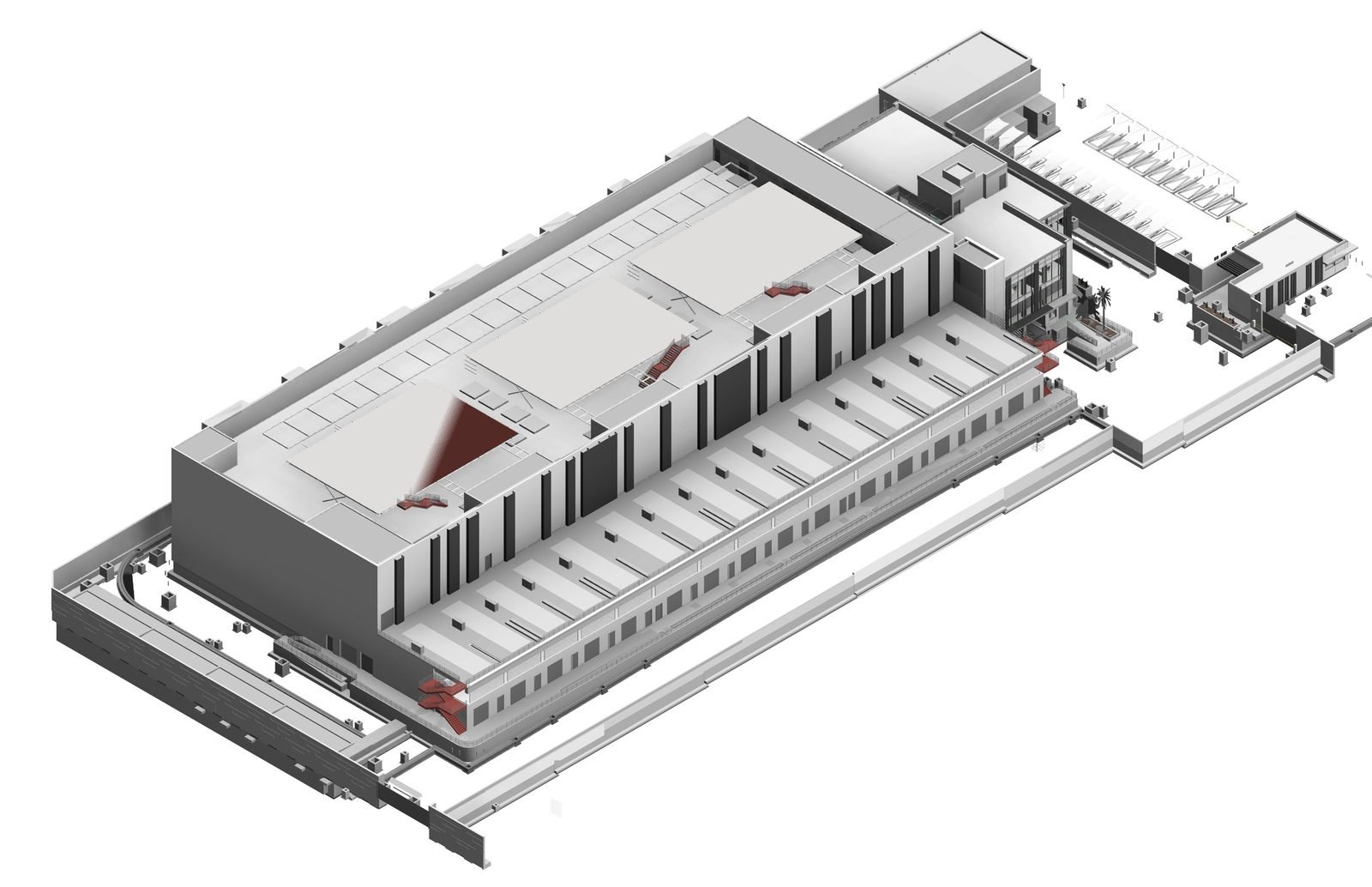
We run LEED from concept to certification (scorecard, energy and daylight modelling, and the documentation) on buildings such as the ZHI headquarters in Jeddah, carried to 80 of 110 points on its published scorecard. The LEED scorecard checks the v5 Platinum gates as you plan; the embodied carbon calculator does the MRp2 arithmetic for the structure. See LEED and green building for the scope.
Frequently asked questions
Can a project still register under LEED v4.1?
Yes, until 30 June 2027. USGBC extended the close of v4 and v4.1 registration by a year in May 2026, and moved the certification sunset to 30 June 2033.
Does LEED v5 require an embodied-carbon reduction?
It requires quantification (MRp2) for every project. A reduction is a credit (MRc2), except at Platinum, where at least 20 percent is required.
What does v5 change for construction sites in the summer?
Construction Management is now a prerequisite, and it includes protecting construction workers from extreme heat. The contractor's heat-stress plan becomes part of the LEED documentation.